Common Wasps
Yellowjackets · Bald-faced Hornets · Paper Wasps
These are the most common stinging wasps encountered around Alberta homes. While species differ in nesting location and appearance, their behaviors and seasonal patterns are broadly similar.
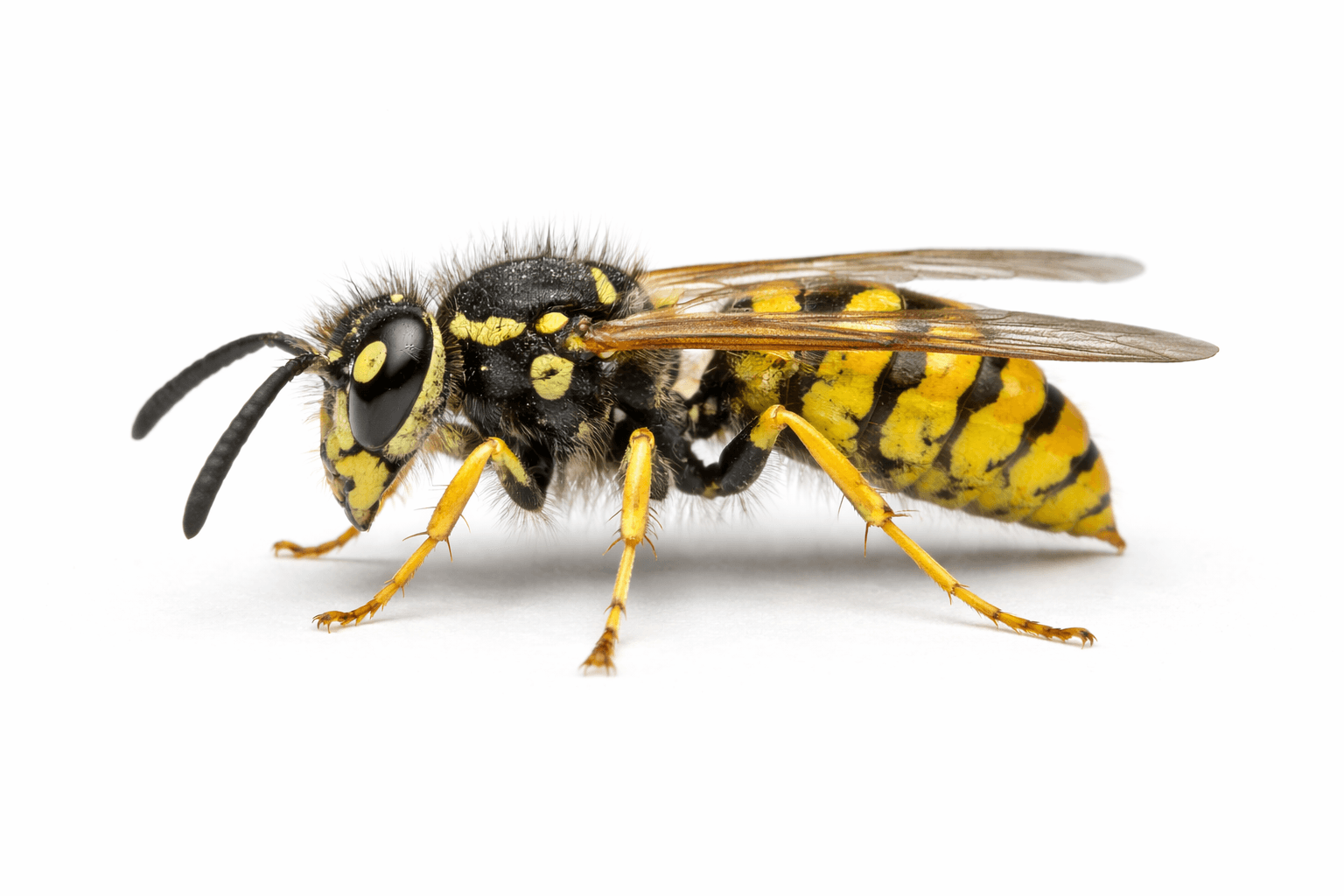
What they look like
- Medium to large insects with narrow waists and folded wings at rest.
- Black, yellow, or white markings depending on species.
- Smooth, shiny bodies compared to fuzzy bees.
Individual wasps vary in size and coloration, but most homeowners recognize them by their rapid flight and smooth, high-contrast bodies.
Colony structure and behavior
- Social insects with a single queen and many workers.
- Colonies grow steadily through the warm months.
- Workers aggressively defend the nest if disturbed.
Defensive behavior is localized around the nest. Away from it, wasps are usually focused on foraging rather than stinging.
Nesting locations
- Yellowjackets often nest in soil, wall voids, or hidden cavities.
- Bald-faced hornets build large paper nests in trees or shrubs.
- Paper wasps favor exposed areas such as eaves, soffits, and railings.
Nest location is the most practical way to distinguish between common wasp types around a home.
Seasonal activity in Alberta
- Activity begins in late spring as queens establish nests.
- Populations peak in mid to late summer.
- Aggression often increases in late summer as food becomes scarce.
Common misidentifications
Bees are generally fuzzy, slower-moving, and far less aggressive. They are not considered a pest in the same way as wasps.
Large solitary insects occasionally mistaken for wasps do not form colonies and do not exhibit defensive swarm behavior.